

Our world is fundamentally shaped by science and matter. Engineering, often considered the practical heir of science, deeply influences nearly every sector and product globally. From its ancient origins with inventions like the wedge, wheel, and pulley, engineering has evolved into one of the most fundamental fields today. Its presence is ubiquitous; we interact with engineering principles daily, whether directly or indirectly.
From the smartphone in your hand to satellites journeying billions of kilometers to dwarf planets like Pluto, engineering’s influence is truly pervasive.
This comprehensive blog post delves into the essence of engineering, highlighting its crucial importance, diverse branches, and compelling reasons why it stands out as an exceptional career choice.
Let’s explore.
Understanding the Core of Engineering
At its core, engineering involves the practical application of scientific and mathematical principles. It is the discipline responsible for designing and constructing machines, various components, buildings, and critical infrastructure like dams. Fundamentally, engineering aims to solve complex problems and improve the quality of human life.
The very existence of engineering stems from the need to address challenges. This field excels at identifying problems, meticulously analyzing them, and then developing innovative solutions that precisely meet specific requirements. Therefore, engineers are essentially expert problem-solvers. They are also continuously engaged in refining existing solutions to better suit evolving needs.
“The problems are solved, not by giving new information, but by arranging what we have known since long.”
– Ludwig Wittgenstein, Philosophical Investigations
While engineering encompasses over 40 distinct branches, they are broadly categorized into four primary disciplines: Chemical, Mechanical, Civil, and Electrical Engineering.
It is a field where professionals consistently strive to simplify complex processes and make life easier through ingenious solutions.

The Roles and Contributions of Engineers
Driving Product Innovation
Every product, from an electric fan providing airflow to complex machinery, represents a solution to a specific problem. In developing these innovations, engineers meticulously examine challenges, conceptualize various solutions, thoroughly analyze them, and ultimately deliver the most effective option for consumers. This process involves integrating scientific principles, mathematical prowess, logical reasoning, economic considerations, relevant experience, and tacit knowledge to create demand-driven products.
Pioneering Service Development
Engineering’s contributions extend significantly to the creation of vital services, notably communication and information networks, alongside various others. The development of global information and news services, accessible worldwide, stands as a prime example of engineering ingenuity and a pivotal factor in the field’s widespread influence. The critical importance of information and communication became especially evident during global events like the COVID-19 pandemic in late 2019 and 2020.
In his seminal work, “Disturbing the Universe” (Sloan Foundation, 1981), renowned physicist Freeman Dyson articulated a key distinction: “A good scientist is a person with original ideas. A good engineer is a person who makes a design that works with as few original ideas as possible. There are no prima donnas in engineering.”
Key Branches of Engineering
While the field of engineering boasts over 40 distinct specializations, the most recognized and foundational branches include:
- Mechanical Engineering
- Electrical and Electronics Engineering
- Civil Engineering
- Chemical Engineering
- Petroleum Engineering
- Electronics and Communication Engineering
- Information Technology
- Computer Science Engineering
- Instrumentation Engineering
- Genetical Engineering
- Nuclear Engineering
The career scope and potential across these engineering branches are largely equivalent. It is highly recommended that individuals select a branch based purely on personal interest, as pursuing a field without passion can lead to dissatisfaction. For example, someone passionate about automotive design (cars and bikes) would likely find it challenging to thrive in a computer-centric engineering role, and vice-versa.
It’s inaccurate to prioritize engineering departments, as all disciplines hold equal importance and vitality. To those who suggest certain engineering sectors are facing declining demand, the clear response is: ‘As long as technology advances and human needs exist, there will always be a robust demand for every branch of engineering.’
For insights into potential salary packages, continue reading the next section of this blog!
Engineer Salaries and Lifestyle in India
Engineering salary packages significantly vary depending on the chosen branch, the employing company, and the specific role. Basing your choice of engineering discipline solely on potential earnings can lead to dissatisfaction. True success and high remuneration often stem from passion, perseverance, diligent work, and consistent effort. As an inspiring example, Sundar Pichai, one of the world’s highest-paid individuals (earning approximately $2 million per year), holds an engineering degree.
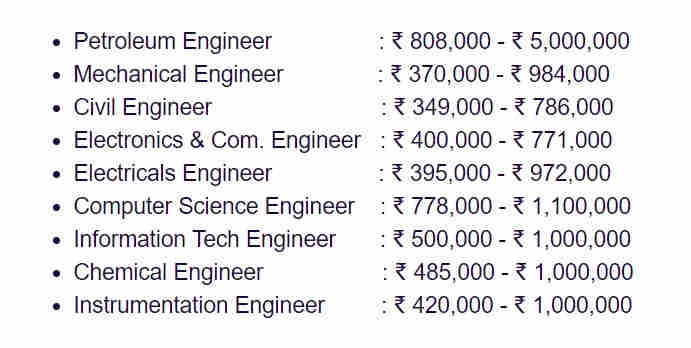
For your reference, here’s an overview of the average annual salary package for newly graduated engineers in India:
Please note: This highlights the average annual salary for freshers. Accumulating experience in the field will undoubtedly lead to significantly higher earning potential.
Unique Advantages of an Engineering Background
An ‘unfair advantage’ refers to a distinctive edge available to those who recognize and leverage it. An engineering education equips individuals with a comprehensive approach to problem-solving, a critical skill benefiting nearly all graduates. This analytical mindset enables engineers to tackle diverse challenges with diplomacy and efficiency, not just within their specific technical field, but across all aspects of life.
Indeed, a significant number of leading global personalities, successful business owners, and CEOs hold engineering degrees, often excelling in fields beyond their initial specialization. For example, Sundar Pichai, the CEO of Google and Alphabet, trained as a Metallurgical Engineer yet thrives in a technology-centric role. This illustrates how an engineering background fosters adaptability and the capacity to excel in various professional domains, provided one possesses determination.
Conclusion: The Enduring Value of Engineering
Engineering has consistently astonished the world with its groundbreaking achievements and vital services, a trend that continues unabated. Ancient marvels such as the Pyramids of Egypt, India’s Brihadeeswarar Temple in Thanjavur, and the ziggurats of Mesopotamia stand as timeless testaments to engineering brilliance. These structures continue to captivate, prompting wonder at how such feats were accomplished with rudimentary technology.
In the contemporary world, engineering demand is boundless and continuously expanding. As a field characterized by abundant opportunities and outcomes integrated into virtually every other discipline, it experiences constant growth and evolution. Therefore,
"Engineering remains the optimal field for meeting the world's evolving demands!"
Join our community by subscribing to our Weekly Newsletter to stay updated on the latest AI updates and technologies, including tips and how-to guides. Also, follow us on Instagram (@inner_detail) for more updates in your feed. For more interesting informational, technology, and innovation content, keep reading The Inner Detail.