
Battery technology underpins nearly every modern technological product, from consumer gadgets to electric vehicles (EVs) and solar energy systems. As the demand for these battery-powered devices continues to surge, so does the imperative for more efficient, economical, and environmentally friendly power solutions. Researchers globally are striving to develop sustainable battery technologies. Among these innovators, MIT’s Angela Belcher stands out, pioneering a groundbreaking method: genetically engineering viruses to produce batteries.
Pioneering Virus-Built Battery Technology
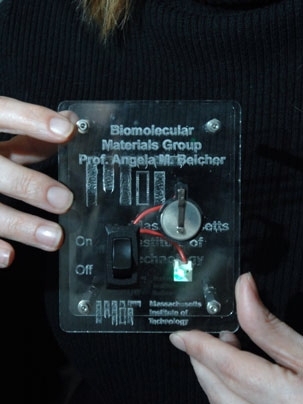
In 2009, bioengineering professor Angela Belcher showcased her revolutionary virus-built battery to then-President Barack Obama at the White House. This innovative use of viruses in both the positive and negative electrodes of lithium-ion batteries was hailed as a significant technological breakthrough. It presented a clean, eco-friendly alternative to the traditional, often toxic, battery manufacturing processes. This pioneering work earned substantial support, with Obama’s administration allocating $2 billion in funding for advanced battery technology, including Belcher’s virus-battery research.
The Genesis of Virus-Based Battery Research
Nature abounds with unique peculiarities and biological mysteries, particularly in the diverse abilities of flora and fauna. The scientific discipline of biomimicry, which draws inspiration from nature’s designs, exemplifies this. Belcher herself revealed that her battery research was sparked by observing the abalone shell. This edible mollusk, found in warm seas, possesses a remarkably structured, lightweight, and robust shell at the nanoscale. Over millions of years, abalones evolved the ability for their DNA to produce proteins that efficiently extract calcium molecules from their mineral-rich aquatic environment, depositing them in precise, ordered layers to construct their shells. Belcher realized that this fundamental biological process could be adapted and applied to viruses, enabling them to design and build useful materials for human applications, marking the true beginning of her innovative research.
Explore Further: Animals that Inspired Technological Innovations – Biomimicry
Conventionally, batteries operate with two electrodes: a positively charged cathode and a negatively charged anode. In lithium-ion (Li-ion) batteries, for instance, lithium ions migrate from the anode (typically graphite) to the cathode (often composed of cobalt oxide or lithium iron phosphate). This controlled flow of ions, when integrated into an external circuit, generates an electric current that can be harnessed to perform work.
The Fabrication Process of Virus-Constructed Batteries
For her pioneering research, Belcher specifically utilized the M13 bacteriophage virus, chosen for its genetic material’s ease of manipulation. Belcher exposed the M13 virus to the specific material she intended for it to interact with. Following this, she extracted these altered viruses and introduced them into bacteria, effectively instructing the bacteria to produce millions of identical copies of the modified virus.
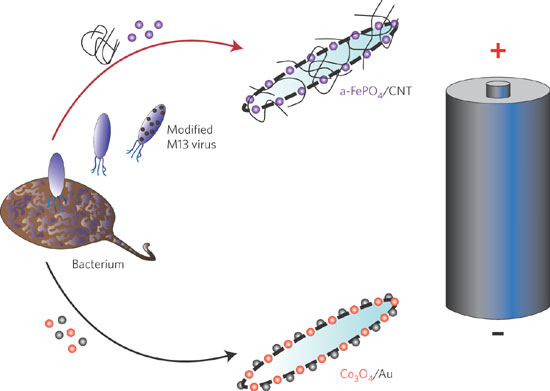
While Belcher did not aim for viruses to ‘understand’ the complex roles of cathodes or anodes, her viruses are meticulously programmed for a precise, simple task. Drawing inspiration from the abalone shell’s natural material synthesis, she genetically engineered the viruses to express a specific protein on their surface. This protein is designed to selectively attract cobalt oxide particles to the virus’s outer structure. As millions of these modified viruses aggregate, their additional proteins facilitate the accumulation of more and more cobalt oxide onto their bodies. This process ultimately forms a cobalt oxide nanowire, essentially a chain of linked viruses, which functions effectively as a battery electrode.
This advanced technique, involving the genetic engineering of viral DNA to specifically attract and bind with a particular element, holds immense potential as a breakthrough in materials science and nanotechnology, according to Belcher. In her research, the viruses successfully gathered cobalt oxide. The remarkable aspect is that their DNA could be precisely tweaked to bind with virtually any other desired metal or element, akin to how breeders select specific traits in animals for desired outcomes.
Enhancing Battery Efficiency Through Viral Assembly
Further stages of the research focused on strengthening the cathode to optimize its partnership with the anode and enhance its overall conductivity. To achieve this, the engineered viruses were coated with iron phosphate. Subsequently, these viruses were guided to incorporate carbon nanotubes, forming a highly conductive network within the material. The research team discovered that integrating carbon nanotubes significantly boosted the cathode’s conductivity without adding excessive weight to the battery. Initial lab tests demonstrated that batteries featuring this novel cathode material could be charged and discharged at least 100 times while retaining their full capacitance. While this number is fewer than the charge cycles of some commercially available lithium-ion batteries, Belcher expressed optimism, stating, “we expect them to be able to go much longer.”
Advantages and Considerations of Virus-Built Batteries
After demonstrating her virus-built lithium-ion coin cell powering a small LED light to President Barack Obama, Belcher clarified her primary motivation. She wasn’t focused on directly competing with established lithium-ion battery manufacturers. Instead, her core objective was to explore a more fundamental question: ‘Can biology be leveraged to resolve challenges that have remained unsolved through conventional methods?’
Developing highly ordered electrode structures is crucial, as it significantly shortens the path lithium ions must travel through the electrode. This reduction in travel distance directly translates to a notable increase in the battery’s charge and discharge rates – a characteristic that Paul Braun, director of the Materials Research Laboratory at the University of Illinois, describes as ‘a holy grail of energy storage.’
Further Reading: MIT Researchers Develop Wearable Device to Influence Dreams
Remarkably, Belcher’s virus-powered batteries demonstrated performance comparable to, or even superior to, those manufactured using conventional techniques. This included advancements in energy capacity, cycle life, and charging rates. However, Belcher emphasizes that the most significant advantage of viral assembly lies in its eco-friendly nature. Traditional electrode manufacturing often necessitates the use of toxic chemicals and high temperatures. In stark contrast, Belcher’s method simply requires the raw electrode materials, room-temperature water, and a population of her specially genetically-engineered viruses.
Belcher states, “My lab is completely focused on developing the cleanest possible technology.”
Initially, Belcher’s unconventional research faced considerable skepticism, with some critics dismissing her ideas as absurd. Nevertheless, time has proven the merit of her work. Her groundbreaking research holds significant promise for the future development of virus-built batteries, particularly for niche applications, even if a virus-powered Tesla might not be on the immediate horizon.
References: https://www.wired.com/story/the-next-generation-of-batteries-could-be-built-by-viruses/ https://news.mit.edu/2009/virus-battery-0402
Join our community by subscribing to our Weekly Newsletter to stay updated on the latest AI updates and technologies, including the tips and how-to guides. (Also, follow us on Instagram (@inner_detail) for more updates in your feed).
(For more such interesting informational, technology and innovation stuffs, keep reading The Inner Detail).

Pingback: Smart Bricks – Red bricks act as power-banks, storing energy – The Inner Detail