

Wearable technology is rapidly transforming our world, capturing the curiosity of tech enthusiasts everywhere. From innovative smartwatches and smart contact lenses to cutting-edge concepts like Google’s smart tattoos, these miniature devices offer incredible possibilities. However, a significant challenge remains: power. While recharging smartwatches is manageable, the implications are far more critical for wearable medical biosensors. What happens if these essential health monitoring devices lose power midday? The constant need to remember and facilitate frequent charging also adds an inconvenient burden to daily routines.
Among the vast array of wearables, medical biosensors are particularly revolutionary for healthcare. They empower doctors with real-time patient data, enabling continuous monitoring of health conditions and immediate alerts if a patient’s health declines. However, these compact biosensors cannot accommodate conventional button batteries, which are too bulky for their design. This limitation has driven scientists to explore innovative, continuous power solutions for these vital devices.
This challenge prompted a dedicated research team at Tokyo University of Science (TUS) to consider a groundbreaking question: What if human sweat could serve as the primary power source for these crucial biosensors? Their fascinating findings are the subject of our discussion.

Generating Electricity from Human Sweat: The Wearable Biofuel Cell
Under the leadership of Associate Professor Isao Shitanda from Tokyo University of Science, Japan, his team successfully developed a novel biofuel-cell array design. This innovative technology harnesses lactate, a naturally occurring chemical found in human sweat, to generate electricity. This power can energize biosensors and even short-term wireless communication devices.
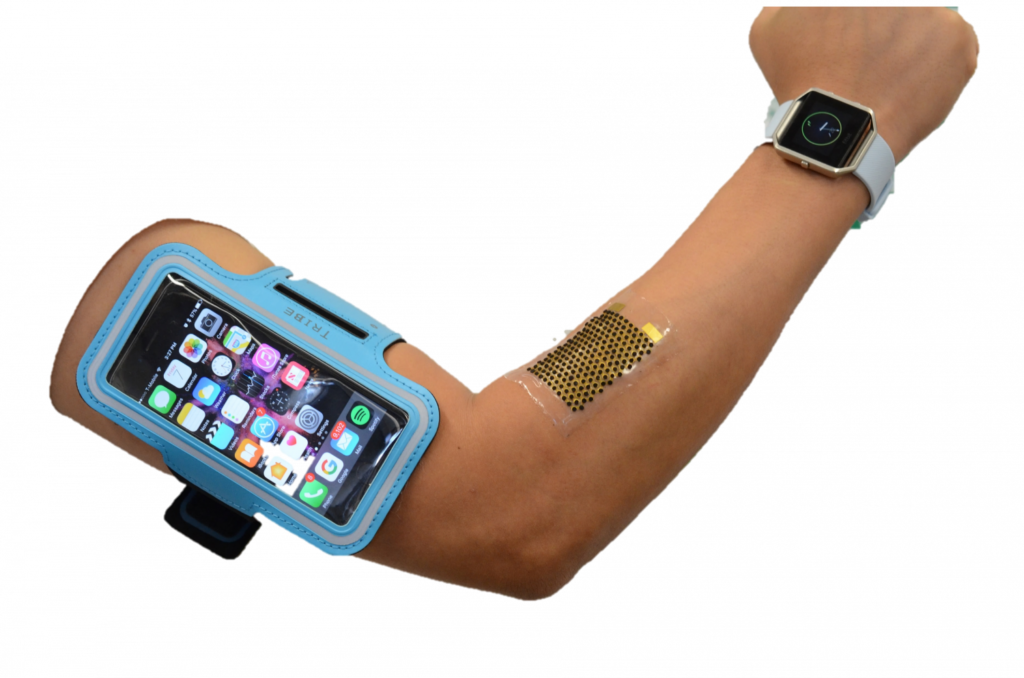
This groundbreaking biofuel cell is designed to function as a flexible, bandage-like device that comfortably wraps around the wearer’s arm or skin. Within this “bandage” lies an array of biofuel cells, meticulously arranged on a water-repellent paper substrate. The specific number of arrays incorporated is determined by the power demands of the connected device. Ingeniously, layers of paper within the design actively collect the wearer’s sweat and transport it directly to the cells using the capillary effect—a natural phenomenon where liquid moves quickly through a porous material, much like water absorbing into paper.
Read this: MIT Scientists develop a Wearable device that could hack your dreams!
The process is straightforward: when a person sweats, the lactate in their sweat chemically reacts with enzymes embedded within the cell’s electrodes. This reaction efficiently generates electricity, which then flows through a current collector fashioned from conductive carbon paste, effectively charging the connected device.
Dr. Shitanda highlighted the impressive performance of their invention, stating, “In our experiments, our paper-based biofuel cells could generate a voltage of 3.66 V and an output power of 4.3 mW. To the best of our knowledge, this power is significantly higher than that of previously reported lactate biofuel cells.” This significant power output underscores the breakthrough potential of their research.
A Pioneering Step in Wearable Power Solutions
While the concept of generating electricity from sweat isn’t entirely new—researchers from Electrical and Computer Engineering at Binghamton University proposed a similar idea in 2017—the Tokyo University of Science team’s approach offers distinct advantages.
The current researchers emphasize that their new model surpasses previous lactate-based biofuel cell designs primarily due to its innovative porous carbon ink structure. This design allows for fabrication using screen printing, a method that significantly boosts its potential for cost-effective, large-scale mass production.
Industry experts widely consider this development a potentially revolutionary advancement for the entire wearable technology sector.
“We managed to drive a commercially available activity meter for 1.5 hours using one drop of artificial sweat and our biofuel cells,” explains Dr. Shitanda, “and we expect they should be capable of powering all sorts of devices, such as smart watches and other commonplace portable gadgets.”
References:
- https://www.tus.ac.jp/en/mediarelations/archive/20210413_0102.html
- https://interestingengineering.com/wearable-biofuel-cells-produce-electricity-from-human-sweat
- https://www.sciencedirect.com/science/article/abs/pii/S0378775321000811
Join our community by subscribing to our Weekly Newsletter to stay updated on the latest AI updates and technologies, including tips and how-to guides. Also, follow us on Instagram (@inner_detail) for more updates in your feed).
(For more such interesting informational, technology and innovation stuffs, keep reading The Inner Detail).
